If you’ve moved beyond beginner lessons but aren’t quite ready for a shortboard, funboards for intermediate surfers could be the missing piece in your progression. A quality funboard sits between the stability of a longboard and the responsiveness of a shortboard. Whether you’re training at a surf camp in Bali or practising closer to home, understanding how to choose and ride a funboard will directly impact your development. This guide explores why funboards accelerate the learning of intermediate surfing tips and build the confidence you need for the next level.
Bridging the Gap Between Longboards and Shortboards
When progressing beyond beginner-level lessons, you face a real problem: longboards get you standing and catching waves, but they’re holding you back from learning proper technique. Shortboards demand precision and power you don’t yet have. That’s the gap.
Funboards for intermediate surfers work because they let you catch as many waves as a longboard would, so you’re not spending half your session paddling. Their narrower tail and thinner rails mean every movement matters. When you pressure the rail incorrectly, you feel it immediately. When you position yourself well, the board responds. You’re learning real technique without the constant failure that a shortboard demands.
A funboard is typically between 6’6″ and 8’6″ in length, with moderate volume concentrated towards the nose. This design recognises that intermediate surfers still need assistance generating momentum, but you’re ready to refine your technique in ways a larger board won’t encourage. The gap closes when your equipment matches where you actually are.
Why Stability is Still Essential for Progression

At the intermediate stage, you’re no longer struggling to stand up or maintain position. Your focus shifts towards where you position yourself on the board, how you direct your weight through turns, and how you read sections of the wave ahead of time.
A stable platform remains essential during this phase. The best surfboard for intermediate level is one that’s forgiving enough to let you experiment with new movements without punishing every mistake, yet responsive enough to reward better positioning and weight distribution.
The Forgiving Nature of Funboard Outlines
Funboards feature wider noses and fuller outlines compared to shortboards. This means they’re more forgiving when you’re not perfectly centred or when you catch the white water of a section. They’ll still float and perform even if your timing isn’t flawless.
This forgiving nature lets you focus on refining your technique rather than fighting to stay upright. You can experiment with rail pressure, footwork and wave selection because the board isn’t constantly fighting back.
Maintaining Wave Count While Learning to Turn
One underrated benefit of funboards is that they let you catch significantly more waves than you would on a shortboard. More waves mean more repetitions, and more repetitions mean faster progression.
If you switched directly to a shortboard, you might spend half your session paddling and missing waves. On a funboard, you’re maximising your time in active practice, which accelerates your learning curve considerably.
Technical Advantages of the Funboard Shape
Funboards offer distinct technical advantages that make them ideal for intermediate progression. Understanding these advantages shows why funboards aren’t a compromise; they’re a strategic choice.
Increased Manoeuvrability Compared to Longboards
A funboard responds to your input far more quickly than a traditional longboard. When you shift your weight or adjust your stance, the board reacts immediately rather than sluggishly. This responsiveness teaches your body to be more precise with its movements.
You’ll feel where your feet need to be during different turn phases. You’ll learn how much pressure to apply to your back foot to initiate a manoeuvre. These lessons transfer directly to shortboard riding later on.
Paddle Power and Early Wave Entry
Funboards maintain enough volume and float to paddle efficiently, but their narrower tail compared to longboards means less drag through the water. This balance gives you real paddle power without the bulky feeling of a longer board.
Early wave entry is crucial at the intermediate level. A funboard lets you catch waves further up the face, positioning you better for the manoeuvres you want to execute. You’re not relegated to riding the whitewater or the very peak.
Understanding Volume Distribution and Rail Control
Funboards concentrate their volume intelligently, tapering towards the tail and edges. This design teaches you about surfboard volume and stability whilst encouraging you to engage the rails actively.
As you progress, you’ll develop sensitivity to how much of your rail is engaged and how that affects turning radius and speed. These lessons are far easier to learn on a funboard than jumping straight to a shortboard. For a deeper dive into how different parts of your board affect your performance, explore the surfboard anatomy guide.
How Funboards Accelerate Your Skills in Bali
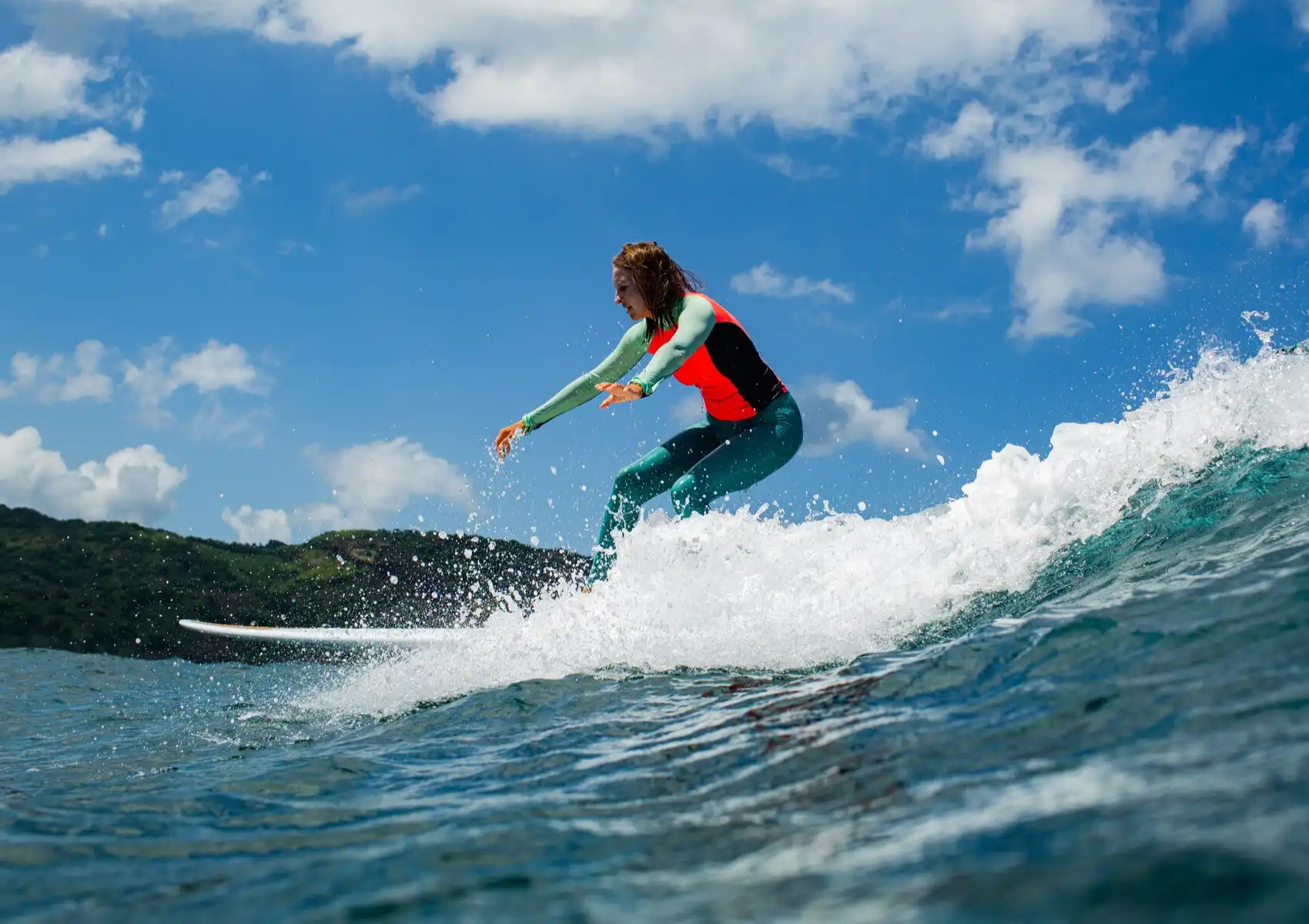
If you’re training at a surf camp in Bali, funboards become even more valuable. Bali’s wave characteristics create unique learning opportunities that funboards are perfectly suited to handle.
Handling the Shifting Peaks of Canggu and Pererenan
Canggu and Pererenan produce multiple peaks that shift throughout each swell period. A funboard’s versatility lets you adapt to these shifting peaks without constantly changing equipment. You can shift your positioning and still find plenty of waves to work with.
Building Confidence in Head-High Swells
When the swell pushes above shoulder height, many intermediate surfers feel tempted to go smaller and faster. A properly sized funboard keeps you confident in bigger conditions. You’re challenged enough to make real progress without being overpowered.
Transitioning Towards Smaller Performance Boards
A funboard is a deliberate stepping stone. By spending time on the right funboard, you’ll build the skills and physical understanding needed to transition to a smaller performance board naturally.
Elevate Your Growth at Mondo Surf Village
Bali’s consistent swells make it ideal for mastering intermediate surfing on the right equipment. At Mondo Surf Village, our coaching recognises that the board you ride fundamentally shapes your progression.
Choosing the Right Funboard from Our Quiver
We stock a curated selection of funboards across different volumes and constructions. Our coaches assess your level, fitness and goals to recommend the funboard that will accelerate your specific progression.
The Advantage of an Intermediate Surf Camp in Bali
Training at a dedicated intermediate surf camp in Bali means you’re surrounded by surfers at your exact level. You’ll progress alongside peers, learn from watching others solve similar challenges, and benefit from a community that understands your journey. To see how our intermediate programme compares to other options on the island, explore our best-rated surf camp in Bali.
Professional Coaching and Video Analysis
Our coaches film your sessions and review footage with you afterwards. You’ll see how your weight distribution affects your turns and where your technique can improve. This feedback loop dramatically accelerates your development.
Book Your Next Step at Our Surf Camp Bali
When you’re ready to progress through the intermediate stage with experienced coaches and Bali’s consistent waves, funboards for intermediate surfers make all the difference. Book your next training package at Mondo Surf Village today. Invest in your progression with equipment and coaching designed specifically for where you are right now.